Benchmark
Wall time of the unpreconditioned conjugate-gradient solve in the
Poisson example (examples/poisson.py), across log-spaced 3D
grid sizes, on the CPU and the GPU. Lower is better.
Test machine
- CPU: Intel(R) Core(TM) Ultra 7 356H (16 logical cores)
- GPU: NVIDIA RTX PRO 500 Blackwell Generation Laptop GPU
Run configuration: 3D grid, hard-coded Laplace operator, no preconditioner,
relative tolerance 1e-6. Times are the solver wall time (total_time_seconds,
excluding setup) for a single run per size.
| Implementation | 32³ (33k) | 48³ (111k) | 64³ (262k) | 96³ (885k) | 128³ (2.1M) | 192³ (7.1M) | 256³ (16.8M) |
|---|---|---|---|---|---|---|---|
| CPU | 0.00808 | 0.0264 | 0.0964 | 0.596 | 2.02 | 10 | 31.7 |
| GPU | 0.0329 | 0.0479 | 0.186 | 0.343 | 0.659 | 2.38 | 6.15 |
(values are solve time in seconds)
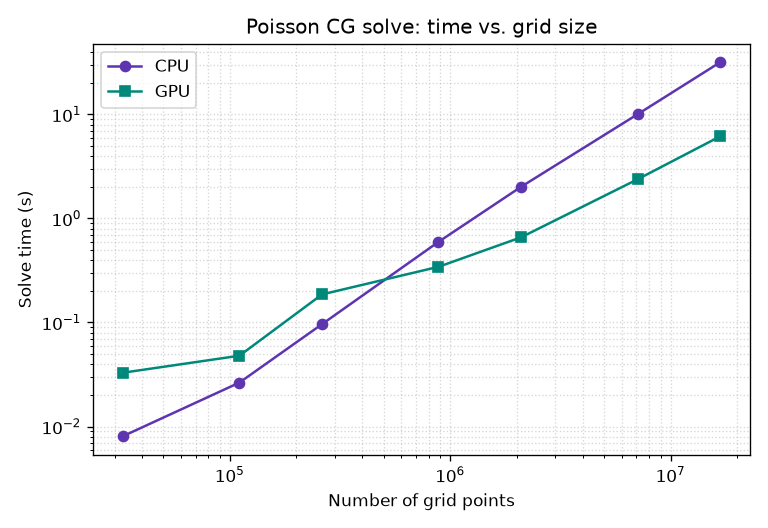
The problem is memory-bandwidth-bound (arithmetic intensity ≈ 0.16 FLOP/byte), so the time tracks memory throughput rather than peak FLOPs, and the unpreconditioned CG iteration count grows with grid size — hence the slightly-steeper-than-linear slope on the log-log plot.
This page is generated by examples/benchmark.py. Regenerate it on your own
machine with: